
What Are Flat Roof Repairs?
Flat roof repairs fix leaks and defects in the low-pitched roofs that cover rear extensions, back additions, dormers, bay tops, balconies and roof terraces. In London almost every terraced house has at least one: the kitchen extension at the back, the roof over the old outrigger, or the flat top of a mansard or dormer. Because water moves slowly across a flat roof rather than running straight off, small defects in the membrane, the upstands or the outlet show up as leaks much sooner than on a pitched roof.
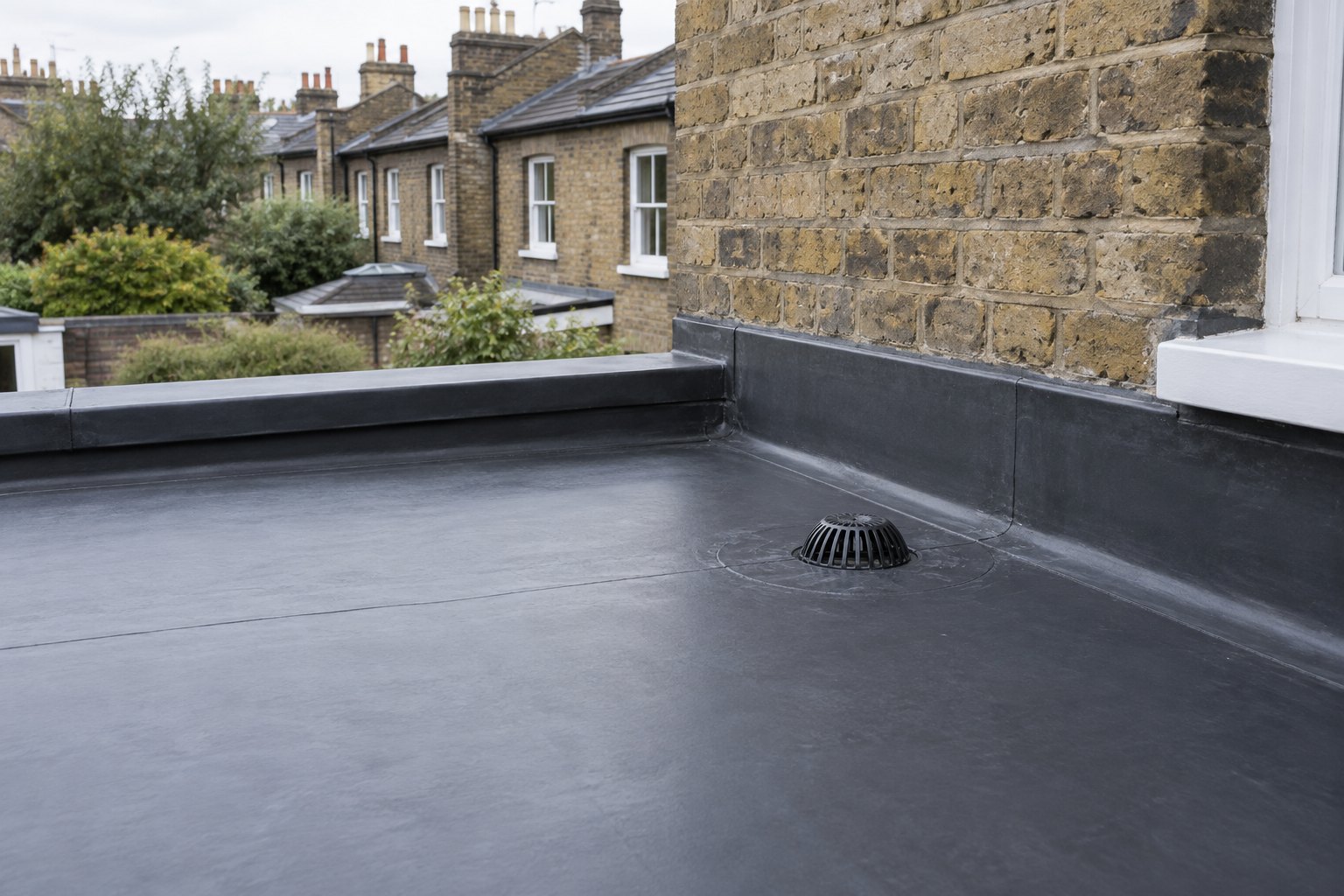
Repair is the right answer when the membrane is basically sound and the problem is local: a split along a joint, a blister, a failed upstand where the roof meets a wall, or an outlet that has pulled away from its hopper. When the deck underneath is soft or the whole membrane has aged, an honest roofer will suggest re-covering rather than another patch.
Signs You Need a Flat Roof Repair
- Water dripping through a kitchen or extension ceiling, often around spotlights or near the wall junction
- Puddles that are still sitting on the roof two days after rain
- Blisters, bubbles or wrinkles in felt, or cracks in the mineral surface
- A rubber (EPDM) membrane that has pulled back from an edge trim or lifted at a seam
- Fine cracks in a GRP fibreglass roof, especially at corners and over deck joints
- Soft or springy areas underfoot, suggesting the timber deck beneath is wet
- Moss and debris collecting around the outlet, with staining down the back wall below
Flat Roof Repair Methods Explained
- Felt repairs. Built-up and torch-on felt roofs are repaired by cutting out blisters and splits and patching with compatible felt. Where a roof has several defects, a new cap sheet laid over a sound base can extend its life.
- EPDM rubber repairs. Tears and lifted seams are cleaned and repaired with EPDM patches, primer and seam tape; edge trims and upstands are refixed.
- GRP fibreglass repairs. Cracks are ground back and relaminated with matting and resin, then top-coated. Poorly laid GRP can crack repeatedly if the deck moves.
- Asphalt repairs. Older mastic asphalt roofs on mansion blocks and 1930s flats are repaired by cutting out and re-melting sections, which needs a specialist.
- Liquid coatings. Cold-applied liquid membranes can seal a tired roof or a complicated area around rooflights and pipes, provided the substrate is dry and sound.
- Detail repairs. Many leaks come from the edges rather than the field of the roof: lead or membrane upstands, cover flashings, drip trims and outlets.
What to Include When Asking for a Quote
Tell roofers what the roof is covered with, if you know, and roughly how old it is. A photo from an upstairs window showing the whole roof, including where it meets the house wall and the outlet, is often enough for a first view. Say how big the roof is (length and width of the extension will do) and whether there are rooflights, a lantern, soil pipes or an air-conditioning unit sitting on it, as each penetration is a potential leak.
Describe where the water shows inside: along the wall junction usually points to an upstand or flashing, in the middle of the ceiling to a split or ponding, and near the outside wall to the outlet or drip edge. Mention if the roof is used as a terrace or walked on to clean windows, because foot traffic changes the right repair material.
A useful quote says what caused the leak, what will be cut out and replaced, which product is being used and whether it is compatible with the existing membrane. It should state whether the deck will be checked for moisture and what happens if the roofer finds wet boards. Ask whether the repair carries a guarantee, and for how long, given the age of the rest of the roof.
How Much Do Flat Roof Repairs Cost?
| Job size | Typical cost |
|---|---|
| Patch a split, blister or lifted seam | £250 – £500 |
| Renew an upstand, flashing or outlet detail | £450 – £900 |
| Overlay or re-cover a section of a rear extension roof | £900 – £1,800 |
These are indicative ranges, not quotations. Access through the house, work above a conservatory and the need for a tower or scaffold all add cost. A full re-cover of a larger flat roof, with a new deck and insulation, typically costs more than this range.
The Flat Roof Repair Process: What to Expect
- Inspection. The roofer walks the roof where safe, checks edges, upstands and outlets and may use a moisture meter on the deck.
- Diagnosis and price. You receive a written explanation of the cause, the proposed repair and whether a re-cover would be more sensible.
- Preparation. The area is cleaned, dried and cut back to sound material; wet decking is replaced if found.
- Repair. New membrane, patches or coating are applied to the manufacturer's instructions, with details dressed into outlets and under flashings.
- Test and tidy. The outlet is cleared and, where practical, the repair is water-tested before the roofer leaves.
Planning Permission and Building Regulations
Repairing a flat roof in the same material does not normally need planning permission. Turning a flat roof into a roof terrace, adding a balustrade or raising the roof level is different and usually needs consent, particularly in London's conservation areas. See the Planning Portal roof alterations guidance.
The extent of re-covering, structural alterations and changes to the covering determine Building Regulations requirements. Confirm the approval route and insulation requirements before starting. See the GOV.UK Building Regulations approval page for the options.
How to Choose a Flat Roof Repair Specialist
- Which flat roof systems are you trained or approved to install and repair?
- Is your repair material compatible with the membrane already on my roof?
- Will you check the deck for moisture, and how will you price any boards that need replacing?
- Do you use a torch on site, and what fire precautions do you take near timber and neighbouring roofs?
- What guarantee do you offer on a repair, as opposed to a full re-cover?
- Can you show photos of similar extension or dormer roofs you have repaired?
Frequently Asked Questions
Can a flat roof be repaired in winter?
Yes, in dry spells. Most membranes and adhesives need a dry surface and minimum temperatures to bond, so a roofer may make a temporary repair in wet weather and return to finish it properly.
Is ponding on a flat roof a problem?
A little water after heavy rain is normal, but water still standing after 48 hours shows the falls are inadequate or the deck has sagged. Ponding speeds up wear and makes any small defect leak.
Should I repair or re-cover my extension roof?
Repair makes sense when the membrane is generally sound and the leak is local. If there are several leaks, the deck is soft, or the felt is over 15 to 20 years old, re-covering is usually better value.
How do I find where a flat roof is leaking?
The leak inside is often some distance from the defect outside, because water travels along the deck and joists. Roofers check upstands, outlets and joints first, and can use moisture meters or controlled water tests to trace the source.