
What Are Chimney Repairs?
Chimney repairs cover the work needed to keep a chimney stack safe and watertight above the roof: repointing eroded mortar joints, rebuilding loose or leaning brickwork, rebedding or replacing pots, renewing the cement flaunching around them, replacing lead flashings where the stack meets the roof, and fitting caps or cowls to disused flues. Most of it happens on the part of the chimney you can see from the street, but the effects are often felt indoors as damp chimney breasts or stains on bedroom ceilings.
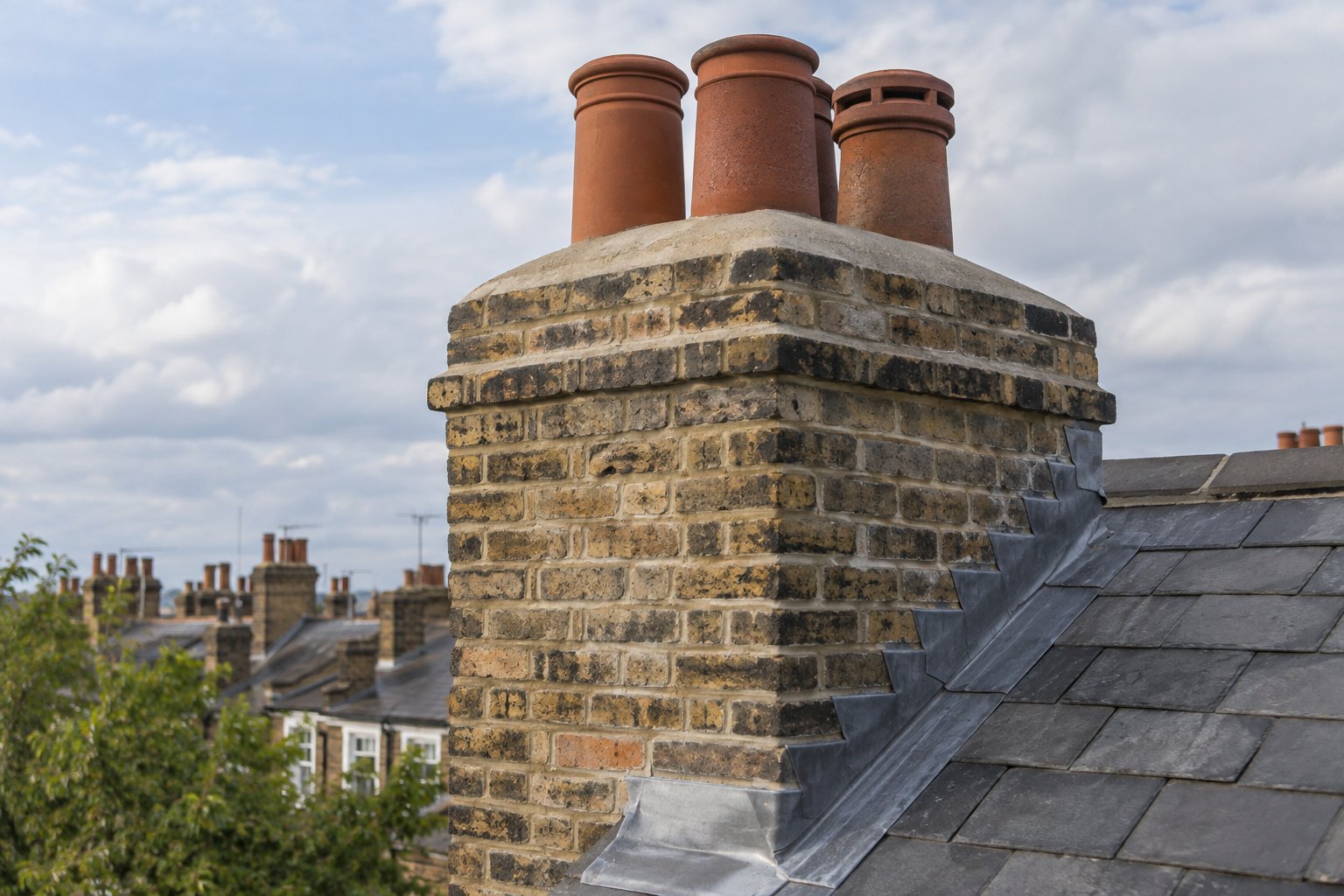
London's housing is full of chimneys, most of them no longer used for open fires. A typical Victorian terrace has a large party-wall stack shared with the house next door, carrying six or eight flues in a single block of London stock brick. Decades of weather, frost and flue gases wear the mortar away, and a stack that has lost its joints can move in high winds. Because the stack sits on the party wall, repairs frequently involve the neighbours as well.
Signs You Need Chimney Repairs
- Mortar missing from the joints so that individual bricks stand proud or are loose
- A stack that visibly leans, often towards the prevailing wind or away from the heated side
- Pots that tilt, have cracked or are missing, and flaunching that is cracked or broken away
- Damp patches or brown staining on chimney breasts, particularly on the top floor
- Lead flashings that have lifted, split or slipped out of the brick joints
- Plants or small trees growing from the stack or flaunching
- Pieces of brick, mortar or pot found in the gutter, on the roof or in the garden
Chimney Repair Methods Explained
- Repointing. Eroded joints are raked out and refilled. On older London stock brick, a lime-based mortar that matches the original is usually more suitable than hard cement, which can trap moisture and damage the bricks.
- Partial or full rebuild. A stack that leans or has loose courses is taken down to sound brickwork and rebuilt, reusing the original bricks where possible, with a new damp-proof tray if needed.
- Pots and flaunching. Loose pots are rebedded and the sloping mortar cap is renewed. Unused pots can be removed and the flue capped, or fitted with vented caps.
- Flashings. New lead soakers, stepped flashings and a back gutter are fitted where the stack meets the roof, which is the most common source of chimney leaks.
- Caps and cowls. Vented caps stop rain entering disused flues while keeping air moving; cowls improve draw and keep birds out of working flues.
What to Include When Asking for a Quote
Say whether the stack is on the party wall and shared with next door, or sits on a gable or in the middle of the roof. Count the pots if you can see them, and mention if any flues are still in use for an open fire, a wood burner or an old gas fire. Photos taken from the street or a back bedroom window, zoomed in on the stack, are very helpful, as is a note of which rooms show damp and after what weather.
Tell the roofer about access: how high the stack is above the ground, whether scaffold needs to go on the pavement or in a neighbour's garden, and whether the stack can be reached from a flat roof or a roof ladder. On shared stacks, say whether your neighbour knows about the problem and would be willing to share the cost, because splitting a scaffold between two houses can halve the access bill for each.
A good chimney quote states what mortar will be used for repointing, how many courses will be rebuilt if any, what lead code is being fitted, what will happen to each pot, and how the scaffold will be arranged. It should say whether disused flues will be ventilated, and how the roofer will record the stack's condition in photos before and after.
How Much Do Chimney Repairs Cost?
| Job size | Typical cost |
|---|---|
| Rebed pots, renew flaunching or fit caps, using existing access | £350 – £800 |
| Repoint a stack and renew its lead flashings, with scaffold | £800 – £1,800 |
| Partial or full rebuild of a multi-flue party-wall stack | £1,800 – £3,500+ |
These are indicative ranges, not quotations. Chimney scaffolds on terraced houses often need to reach over the roof slope, and a pavement scaffold needs a council licence, so access is a large share of the price. Sharing the cost with a neighbour on a joint stack can reduce it considerably.
The Chimney Repair Process: What to Expect
- Inspection. The roofer assesses the stack from the ground, a drone or the roof, and checks the loft and chimney breasts for damp.
- Agreement with neighbours. For shared stacks, the work, access and cost split are agreed, and a party wall notice is served if required.
- Scaffold. A scaffold with a working platform around the stack is erected, with any highway licence in place.
- Repair. Pots are removed if necessary, brickwork is repointed or rebuilt, pots rebedded, flaunching renewed and new flashings dressed in.
- Final check. Flues in use are checked to be clear, caps are fitted to disused flues, and photos of the finished stack are provided.
Planning Permission and Building Regulations
Repairs that keep the stack's appearance the same do not normally need planning permission. Removing a stack, lowering it or changing its pots can need consent in a conservation area or on a listed building, and chimneys are often a valued part of a London street scene. Check with your borough, and see the Planning Portal guidance on chimneys and flues.
Most of London is a smoke control area, which limits what can be burned in an open fire or stove; relining a flue or fitting a new appliance brings Building Regulations and fuel rules into play. The GOV.UK smoke control rules explain the position. If the stack sits on a party wall, the Party Wall etc. Act 1996 guidance may apply.
How to Choose a Chimney Repair Specialist
- Will you use a lime mortar suited to my stack's original brickwork?
- Can you rebuild using the original bricks, or source a close match?
- How will the scaffold be set up to reach the stack safely?
- Are you comfortable working with my neighbour on a shared stack and splitting the costs?
- How will you deal with disused flues so they stay ventilated?
- Will you give me photos of the stack before, during and after the work?
Frequently Asked Questions
Why is my chimney breast damp when I never use the fire?
Rain can enter through open pots, cracked flaunching, porous brickwork or failed flashings. Disused flues that have been sealed at both ends without ventilation also trap moisture, which can show as damp patches on the breast.
Do I need my neighbour's agreement to repair a shared chimney?
If the stack sits on the party wall, work to it may fall under the Party Wall etc. Act 1996, and a notice may be needed. In practice, agreeing the work and sharing the scaffold with the neighbour usually saves both households money.
Should I remove my chimney stack instead of repairing it?
Removing a stack is a bigger job than repairing it, can affect the neighbouring house and may need planning consent. It also removes the option of a fire later. Repair is usually cheaper unless the stack is being taken out as part of wider alterations.
How often should a chimney stack be checked?
A visual check every few years, and after severe storms, is sensible. Many problems can be spotted from the ground with binoculars, and a roofer can check the stack while carrying out other roof work.