
What Are General Roof Repairs?
General roof repairs cover the everyday faults that let water into a pitched roof without meaning the whole covering has failed: a slate that has slid out of its course, a ridge tile whose mortar has washed away, a split in the lead lining a valley, or a verge that has started to shed its pointing. A repair puts back a small area of an otherwise sound roof, so the first job of any roofer is deciding whether the problem really is local or a symptom of a roof reaching the end of its life.
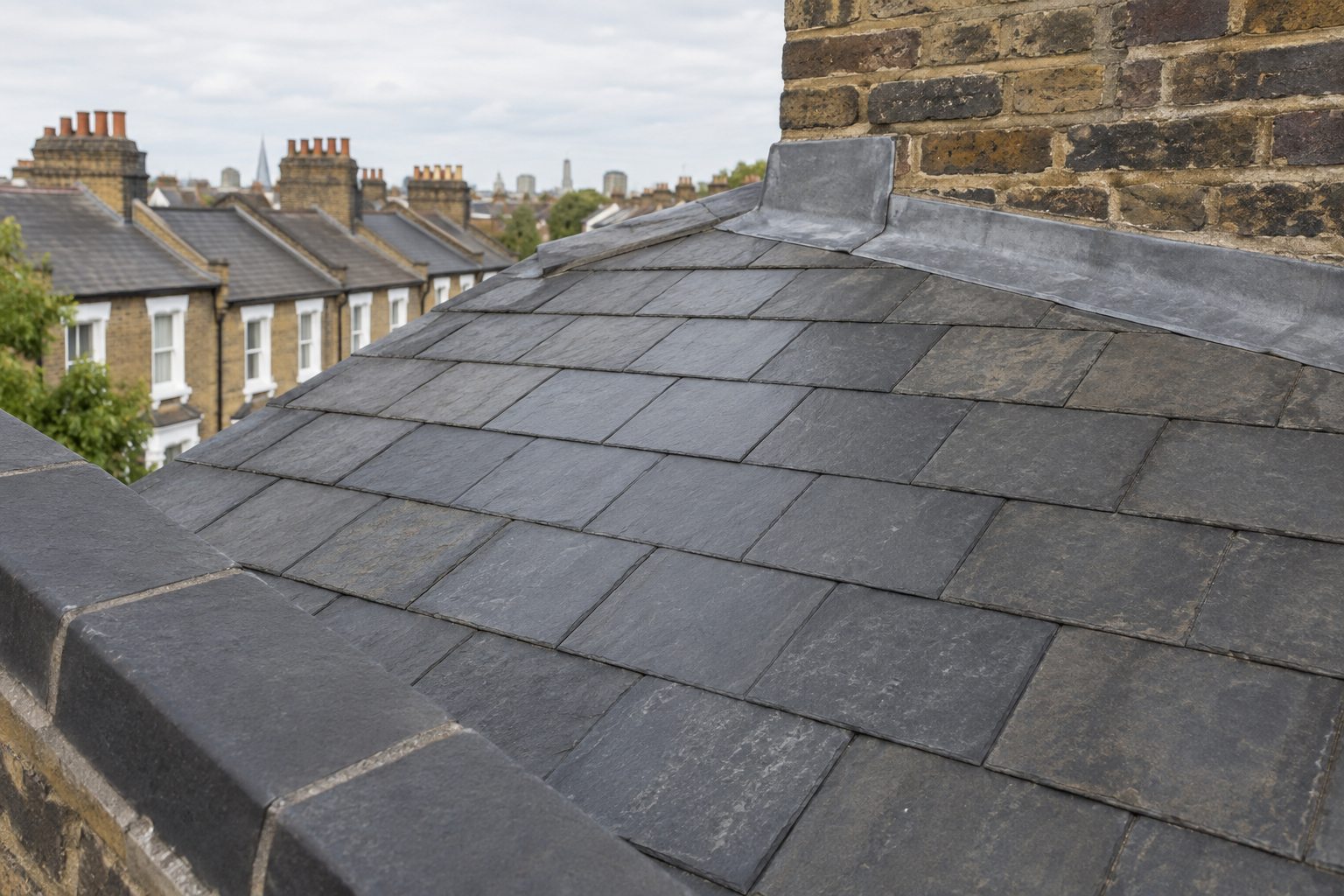
London throws up some repair jobs that are rarely seen elsewhere. Many Victorian terraces have a butterfly or "London" roof, where two slopes fall inwards to a central valley gutter hidden behind a front parapet wall. When that valley's lead cracks or its outlet through the back wall blocks with leaves, the water ends up in the top-floor ceiling rather than on the pavement. Mansard roofs, slate-hung dormers and the small pitched roofs over back additions all have their own weak points, and a roofer who works in the city every week will know where to look first.
Signs You Need a Roof Repair
- A brown stain on a top-floor ceiling that grows after heavy or wind-driven rain
- Slates or pieces of tile in the front garden, on the path or caught in the gutter
- Slates held in with copper or lead tingles that have started to bend open
- Ridge or hip tiles that have lifted, or mortar joints you can see daylight through from the loft
- Water overflowing a parapet wall or pouring from the rear hopper in a storm, suggesting a blocked central valley
- Damp patches beside a chimney breast or where a party wall meets the roof slope
- Wet or stained timbers, or damp insulation, when you look into the loft with a torch
Types of Roof Repair Explained
- Slate and tile replacement. Individual broken or slipped slates are refixed with a tingle or, better, by removing the slates above and nailing in a new one. Matching reclaimed Welsh slate or the correct clay tile profile matters on older streets.
- Ridge, hip and verge work. Loose ridge and hip tiles are lifted and rebedded in mortar, or converted to a dry-fix system with mechanical fixings. Verges can be repointed or finished with dry verge caps where the look is acceptable.
- Valley and parapet gutter repairs. Lead-lined valleys behind parapets can be patched, relined with new code 5 or code 6 lead in correctly sized bays, or re-covered with a single-ply or GRP lining where appearance allows.
- Flashing repairs. Stepped and cover flashings where the roof meets a chimney, party wall or dormer cheek are re-dressed, rewedged and repointed, or replaced if the lead has cracked with age.
- Storm and localised damage. Sections torn by high winds or damaged by a fallen branch are made watertight quickly, then properly repaired once the extent of damage is clear.
What to Include When Asking for a Quote
Say where in the house the water appears and when: only in driving rain from the south-west, after days of steady rain, or during summer cloudbursts. That pattern tells a roofer whether to look at the slope itself, the flashings or a hidden valley that is overflowing. If you can, take a photo from the loft of the wet area and one from the street or back garden of the same part of the roof, marked up with where the stain is.
Explain the roof shape and access honestly. A front parapet, a butterfly roof reached only through a small hatch, a basement lightwell below the front elevation or a rear roof that can only be reached through a neighbour's garden all change how the job is done and whether a scaffold, tower or cherry picker is needed. If the house is split into flats, say who owns the roof and whether the freeholder or managing agent needs to approve the work.
A useful quote names the exact defects found, the materials to be used (reclaimed or new slate, the lead code, mortar or dry-fix), how access will be provided and whether scaffold licence fees are included. Ask the roofer to photograph the problem and the finished repair, and to state how long the workmanship guarantee lasts on a repair to an older roof.
How Much Do Roof Repairs Cost?
| Job size | Typical cost |
|---|---|
| Refix or replace a few slipped slates or tiles, reachable without full scaffold | £200 – £500 |
| Rebed a ridge, repoint verges or re-dress lead flashings | £500 – £1,200 |
| Reline a central valley or parapet gutter, with scaffold and licence | £1,200 – £2,000+ |
These are indicative ranges, not quotations. Scaffolding is often the single biggest line on a London repair, and a pavement scaffold usually needs a council licence as well. Confirm whether VAT, access, waste removal and making good inside are included.
The Roof Repair Process: What to Expect
- Inspection. The roofer checks the loft, the affected ceiling and the roof itself, using a ladder, drone, binoculars or a roof hatch to find where water is getting in.
- Written scope. You receive a description of the defects, photos where possible and a price, with access arrangements and any licence costs spelled out.
- Access set-up. Scaffold or a tower goes up, neighbours are told, and any highway licence is displayed.
- Repair. Damaged slates, tiles, mortar or lead are removed and replaced, with surrounding areas checked while access is available.
- Check and handover. The roofer clears gutters and debris, shows you photos of the finished work and confirms the guarantee in writing.
Planning Permission and Building Regulations
Like-for-like repairs to a roof do not usually need planning permission. The exceptions matter in London, where a large share of streets sit in conservation areas and many have Article 4 directions controlling roof materials on front slopes. Swapping natural slate for concrete tiles, or changing a ridge detail, can need consent there, and work affecting the special character of a listed building can need listed building consent. See the Planning Portal guidance on roof alterations and check with your borough before changing materials.
The extent of re-covering, structural alterations and changes to the covering determine Building Regulations requirements. Confirm the approval route and insulation requirements before starting. See the GOV.UK Building Regulations approval page for the approval routes.
How to Choose a Roof Repair Specialist
- Will you show me photos of the defect before you start and of the finished repair?
- Can you source reclaimed slate or the matching tile profile for my roof?
- Who arranges the scaffold and the council licence, and is that in the price?
- Do you have public liability insurance covering work at height on terraced houses?
- Are you a member of a trade body such as the NFRC, and what guarantee do you give on repairs?
- If you find the roof is beyond repair, how will you tell me and what would the alternative cost?
Frequently Asked Questions
Why does my roof only leak in certain storms?
Wind direction and rainfall intensity both matter. A slate that has slipped slightly can stay dry in gentle rain but let water in when wind drives rain uphill under it, while a blocked valley gutter may only overflow in a heavy downpour.
Can a roofer repair a roof without scaffolding?
Sometimes. Small repairs on a low roof or those reachable from a roof hatch may be done with ladders, roof ladders or a tower. Most work on a two- or three-storey London house needs scaffold or other edge protection to be done safely.
Is it worth repairing an old slate roof?
Often it is, if the slates are sound and the problem is local. When many slates are delaminating or the nails have rusted across the whole slope, repeated repairs tend to cost more over time than re-covering.
Who pays for roof repairs in a converted house?
That depends on the lease. In many converted London houses the roof belongs to the freeholder and the cost is shared through the service charge, but some leases make the top-floor flat responsible. Check the lease before commissioning work.